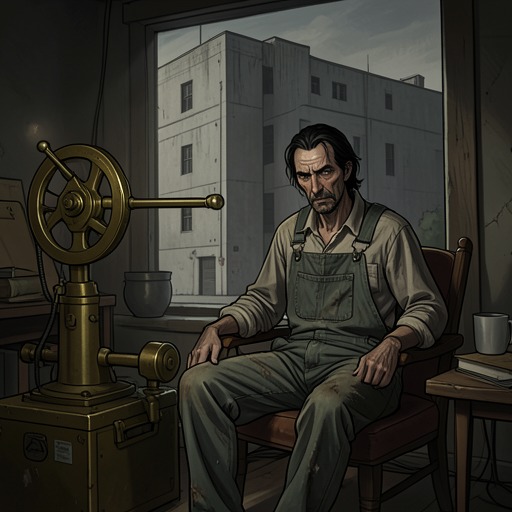
Scott’s final six-day countdown
The Shrinking ManScott’s final six-day countdown is the point at which Scott Carey’s ongoing shrinkage takes the form of an explicit deadline. On Monday, March 10, with the day already half over, he recognizes that he has six days left before he will be gone. The countdown gives shape to a fate he cannot picture: each remaining day brings him closer to disappearance, while his improvised calendar and daily needs insist on time’s ordinary passage.
The Calendar and the Deadline
The countdown begins in the uneasy interval between a date that can still be marked and an ending that Scott cannot conceive. His calendar is a scrap of wood bearing charcoal strokes; he glances at it to establish that it is Monday, March 10, and that the day is already half gone. The detail makes his reckoning practical and precarious at once. He has no formal calendar or dependable instrument of measurement, only marks he has made himself and the knowledge that six days remain. That knowledge arrives as a fixed statement rather than a distant possibility. Scott has spent the past year and a half trying to imagine the end, but his mind has repeatedly resisted the task by supplying hoped-for alternatives: the injections might begin to work, the process might stop, or something else might happen. Now the countdown closes off those evasions. He sees that he is already small enough for the deadline to be real, even though its final meaning remains beyond his understanding.
Time Against Continuing Shrinkage
The six days do not promise a pause or a leveling-off. Scott’s despair is connected to the process’s unbroken continuation: he has made adjustments, but shrinking has never tapered or stopped. His sense of the future is therefore not an expectation that his condition will stabilize; it is the knowledge that the same change will go on until he is gone. The short deadline concentrates the dread produced by a year and a half of failed hopes into a finite span. The household’s heating system supplies a contrasting measure of time. Across the cellar, the oil-burner flame flares when the temperature above falls and the thermostat activates, making the bed beneath Scott vibrate. The house continues its familiar cycles beyond his control. He thinks of his wife and daughter, but wonders whether his size has removed him from their world: even Beth might crush him without knowing it. The countdown thus measures more than his bodily change. It brings into view the widening gap between his continued inner life and the increasingly slight physical presence by which his family might perceive him.
The Last Days as Material Precarity
For Scott, the approaching end coexists with immediate problems that do not wait for the final day. The spider he has driven away is still alive and may attack again; food will run out in two days; reaching water is becoming harder; and he must keep altering his clothes as his body shrinks. Escape from the cellar still seems impossible. These specific demands make the countdown a lived interval rather than an abstract prediction: Scott must continue finding food and water and protecting himself even while he believes that none of these efforts can alter the deadline. His dread becomes especially precise in his fear of what will happen between Saturday night and Sunday morning. The time boundary gives his otherwise unimaginable disappearance a near-term setting, without making the event any easier for him to visualize. After eating, he adds another careless charcoal stroke to the wood. Wednesday and Thursday, then Friday and Saturday, pass in his thoughts toward a point he cannot represent. Chronology, once something he could record, is losing its usefulness as the days approach what he calls nothing.
Nothingness and the Limits of Imagination
Scott distinguishes disappearance from death because death, however unknown, remains a concept within life; shrinking into nothingness does not. The distinction explains why the six-day forecast can be certain and still be incomprehensible. He can count down toward it, but counting cannot make it imaginable. The calendar gives the ending a measure without giving it a form. That failure of imagination has already shaped his responses to danger. In despair, he wonders why he keeps fleeing the spider rather than allowing it to catch him, since its attack would at least end the struggle quickly. Yet after driving it away, he continues to worry that it may be waiting for him. His actions preserve life without resolving what that life is becoming. The countdown makes this contradiction stark: the prospect of an ending intensifies both his temptation to stop struggling and the persistence of his instinctive efforts to survive.
Isolation and Narrative Significance
The deadline also sharpens Scott’s loneliness. He wishes he could tell someone what he feels or be with Louise Carey, even if she did not know he was there, but he is alone in the cellar. The family he thinks of remains physically above him and socially uncertain in his mind. The six days are therefore not simply a private calculation of bodily duration; they are a narrowing span in which he cannot make his fear shared or secure the comfort of contact. His memory of becoming a newspaper spectacle adds another contrast. Public attention once provoked such fury that he went to the city and broke his contract; now the urgent problem is not how his condition is displayed but whether he can communicate his experience to anyone at all. The countdown draws these pressures together without offering a cure, rescue, or clear image of what follows. Its force lies in the difference between the precision of the remaining days and the absolute uncertainty of the nothingness toward which they lead.